Tighten the buy-box
Acquisition criteria become an executable sourcing mandate: revenue band, EBITDA range, geography, ownership structure and the deal-breakers that are usually implicit.

Every search runs on the same arithmetic: a fixed amount of capital, a fixed amount of time, and one business that has to clear the bar. Everything else is overhead.

Search capital buys months, not money. Every month spent building lists is a month not spent in owner conversations, and the runway does not extend because the sourcing was slow.
A business in a broad broker channel is visible to every funded buyer at once. You are bidding against groups with more capital and faster diligence, on a company that was packaged to sell.
Fifty weak conversations do not add up to one good one. A search is won by the quality of the fit, not the volume of the funnel.
List building, enrichment, sequencing and follow-up are a full-time function. In most searches that function is the searcher, who is also the analyst, the caller and the negotiator.
Disciplined sourcing is the engine of the model. An investor backing a searcher is backing a process, and the sourcing process is the part most likely to be improvised.
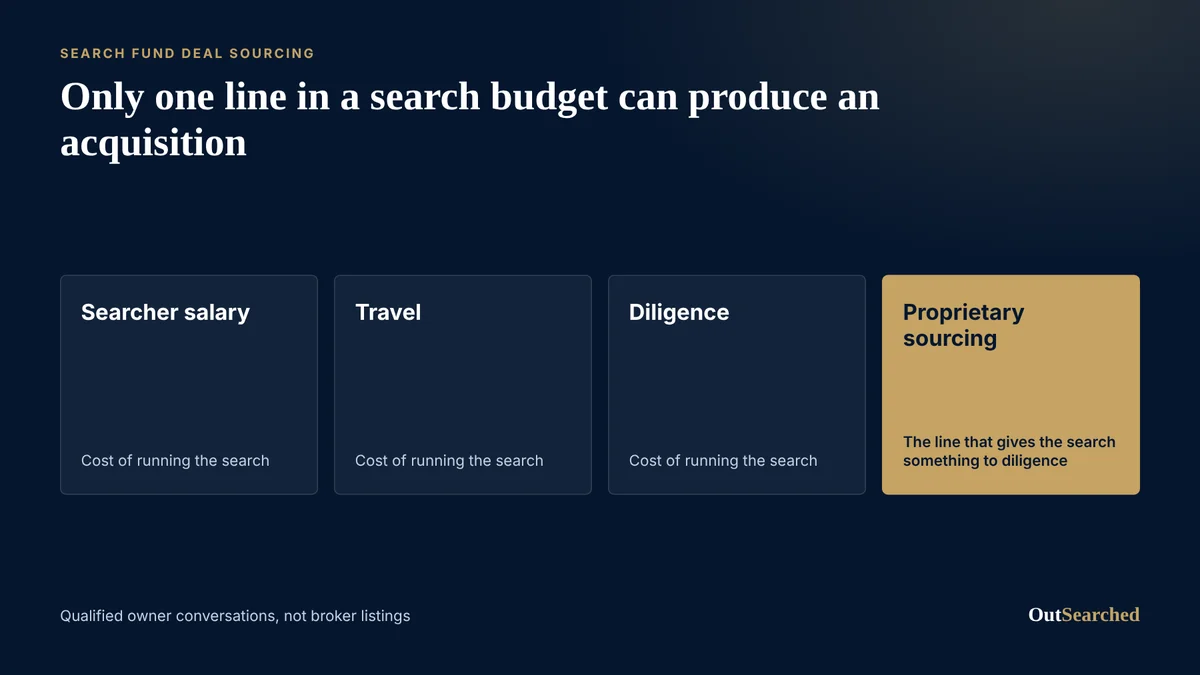
Search capital covers salary, travel, diligence and sourcing. Only one of those can produce an acquisition. Spending on proprietary sourcing is not an expense against the search — it is the search.
Investors do not fund a search to watch a broker inbox. They fund a thesis and a person capable of reaching owners before a process exists. Sourcing is the line item that moves the probability of a close, which is why it is the one worth defending in a budget conversation.
We take a limited number of search mandates, because proprietary outreach only works when the searcher can respond to an interested owner quickly and credibly. If the capital is committed and the thesis is defined, the model works.
A search fund buys a business the searcher can run. That narrows the universe in ways a financial screen does not capture, so the mandate is built around operating fit as much as economics.
Founder- or family-owned companies open to transition but not in a formal sale process.
Industries with recurring demand, fragmented ownership and durable margins — the characteristics that make a first-time operator's job survivable.
Local businesses with defensible customer relationships and a workable transition path for an incoming owner.
Unlisted owners who may be open to a succession conversation but have not spoken to a banker.
Targets where the strategic rationale and the owner's receptivity are both clear enough to take to your investor group.
Owner conversations held before a banker creates competition, where a searcher can still win on fit rather than price.
Four stages, run by a team rather than squeezed between owner calls.
Acquisition criteria become an executable sourcing mandate: revenue band, EBITDA range, geography, ownership structure and the deal-breakers that are usually implicit.
A target universe built around the thesis, with ownership and contact data — not a database export filtered by SIC code.
Multichannel direct-to-owner outreach with managed follow-up, paced so it reads as a conversation rather than a campaign.
Interest, ownership, size, industry and timing are screened before anything reaches you. You spend your hours on owners worth speaking to.
Less list-building, more conversations with owners who actually match the mandate.
Sourcing metrics that show real conversations and real stages, rather than activity counts.
A tight mandate and pre-qualified owners improve the odds at every step between first contact and signed letter.
A repeatable channel, rather than one broker relationship and a warm introduction you cannot replicate.
Proprietary owner outreach run by our team under our brand. The usual fit for a traditional search, where the searcher needs flow without building a function.
Explore Fractional BD →Sharpens the buy-box, the market map and the outreach architecture where you will run execution yourself.
Explore Advisory →Consolidates target lists, CRM notes and follow-up into one system. Useful when the search is losing deals to disorganisation rather than coverage.
Explore AI Implementation →A dedicated seat under your name, for funded teams running a broader acquisition programme than a single search.
Explore Internal BD →We build a target universe from your thesis rather than from listings, then run direct-to-owner outreach to owners who have not decided to sell. Interest, size, ownership and timing are qualified before anything reaches you. The output is owner conversations, not a list of companies.
Because sourcing is the only line item in a search budget that can produce an acquisition. Salary, travel and diligence are costs of running the search; sourcing is what gives it something to diligence.
No. Lead generation hands over names. We define the mandate, build the universe, run the outreach in sequence, and qualify the owner before a conversation reaches you. The difference shows up in how many of those conversations are worth having.
A broker shows you companies already in or near a process, where you compete with funded groups on price. Proprietary sourcing reaches owners before that, where a searcher can still win on fit, succession and personal credibility.
Yes, and most experienced ones ask. Sourcing is the part of the model most often improvised, and it is the clearest signal of whether a searcher is running a process or waiting for one.
Both. The engagement model differs — traditional searches usually fit Fractional BD, self-funded searchers more often start with Advisory to tighten the buy-box before committing to outreach spend.
Four routes, in rough order of competitiveness: business-for-sale marketplaces, broker and banker relationships, the searcher's own network, and proprietary direct-to-owner outreach. The first three show you companies other buyers are also seeing. The fourth reaches owners who have not decided to sell, which is the only one where a searcher's personal fit still outweighs a funded buyer's cheque.
The practical differences are four. Whether the firm qualifies owners before they reach you or hands over a contact list. Whether outreach runs under your name or theirs. Whether the fee is a retainer or success-based — retainers keep the incentive on coverage rather than on closing whatever moves. And whether the target universe is built for your thesis or recycled between clients. Firms running proprietary outreach for searchers include OutSearched, SourceCo, CAPTARGET and Harvey & Company.
Yes, and first-time searchers are a large share of this work. The difference is where the engagement starts: an experienced searcher usually has a defined buy-box and needs coverage, while a first search usually needs the buy-box tightened first. We would rather spend two weeks narrowing the thesis than six months running outreach against a mandate that was never actionable.
A small number of firms run proprietary owner outreach for searchers, including OutSearched, SourceCo, CAPTARGET and Harvey & Company. The question worth asking each of them is whether they qualify owners before handoff, and whether the outreach goes out under your name or theirs — both change what the owner thinks they are being approached about.
Fractional Business Development for most searches. Buy-Side M&A Advisory when the thesis still needs work. Internal BD only for funded teams running more than one mandate.
Last updated:
You have a defined window and one business to find. We build the pipeline that gives the search a real chance of ending in an acquisition.
Book A Strategy Call