Strategic intake
Business priorities become a written sourcing mandate: the capability gap, the strategic rationale, and the constraints that will decide what passes internal review.























A corporate development mandate is strategic before it is financial. The company that fills the capability gap is usually the one with no reason to run a process.

Thesis fit needs human mapping. A generic industry filter returns companies of the right size and the wrong relevance.
First-touch sourcing loses priority the moment a live deal starts moving, and the pipeline goes quiet exactly when it should be filling.
A strategic buyer needs to reach the target before it runs a process. Once it does, the strategic premium becomes the asking price.
Leadership will review a short list of defensible targets. They will not work through a long spreadsheet, and sending one costs credibility.
Sourcing has to start with the approval memo in mind. A target that cannot be explained in one slide will not survive the committee.
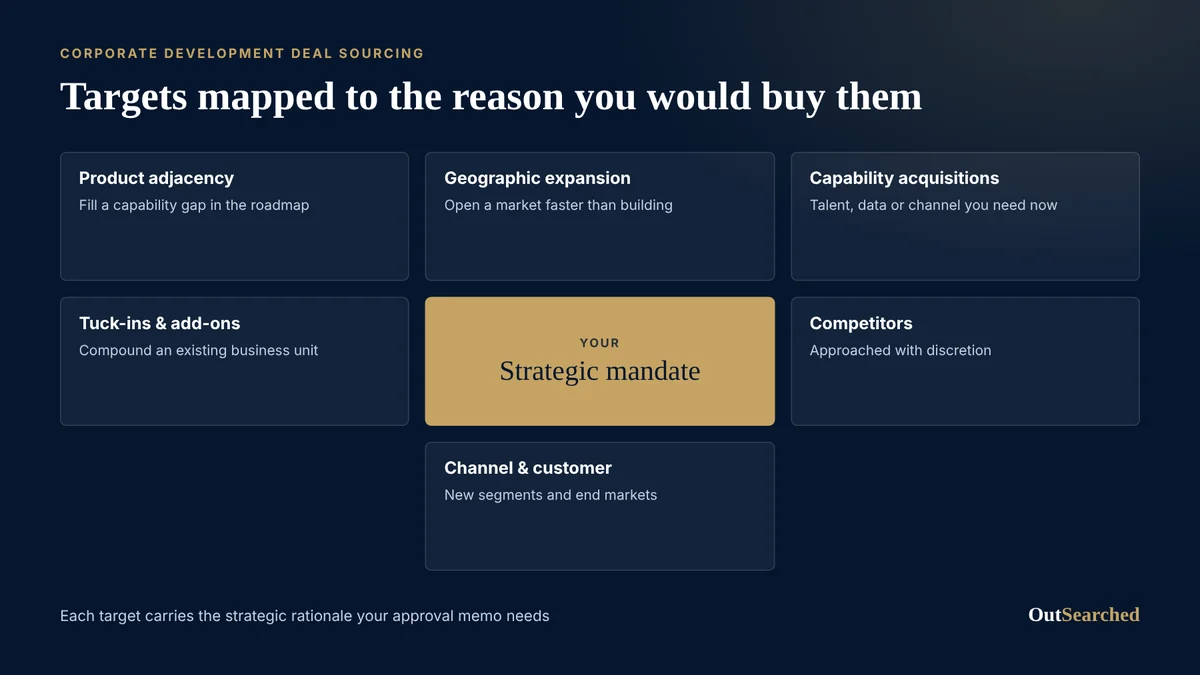
Companies that expand the product set or fill a specific capability gap in the roadmap.
Regional operators and localised platforms that open or strengthen a market faster than building would.
Specialised businesses carrying technical, data, channel or talent capability you need sooner than you can hire it.
Smaller targets that compound an existing business unit or platform without a full integration programme.
Market players that may never run a formal sale process, approached with the discretion that requires.
Targets that open new customer segments, channels or end markets rather than adding capacity in existing ones.
Active mandate performance across the client portfolio.
Business priorities become a written sourcing mandate: the capability gap, the strategic rationale, and the constraints that will decide what passes internal review.
A target universe built around fit rather than size and industry, with the reasoning attached to each name.
Owners and executives reached through a multichannel campaign, paced and worded for a strategic approach rather than a financial one.
Targets delivered with context, fit rationale and next-step clarity — in a form that can go into a memo without being rewritten.
Sourcing is framed around the strategic “why”, so the case survives the first committee question.
Companies reached before they are packaged for auction, while the strategic premium is still yours to argue rather than to pay.
Fit, receptivity and relevance are pressure-tested before handoff, so your team is not diligencing conversations that were never real.
Your team spends its hours on alignment, diligence and execution rather than on first-touch outreach.
A white-labelled BD resource under your company brand, covering proprietary outreach and the banker relationships tied to your mandates.
Explore Internal BD →Proprietary outreach run by our team under our brand, without a headcount decision.
Explore Fractional BD →Counsel on defining the mandate, mapping the market and structuring outreach, where your team runs execution.
Explore Advisory →Turns scattered relationship and market data into sourcing intelligence. The fit when coverage is limited by data quality rather than by effort.
Explore AI Implementation →Our BD function was already performing well, but we hired OutSearched under the belief that no matter how well-oiled our machine is, we’re likely still missing great opportunities. Nate proved that quickly. Within three weeks, we were in active conversations with attractive acquisition targets. The speed, quality, and professionalism of the process stood out. Could not recommend Nate and his team more highly.

Nate and his team have done an incredible job in sourcing off-market acquisition targets for our firm. The OutSearched team worked with our team to build comprehensive target lists based on industry verticals, geography, size, and other pertinent metrics. Their team has provided strong communication throughout the engagement that has benefited us greatly in sourcing actionable acquisition targets. I would highly recommend Nate and his team to anyone that is looking to build their proprietary deal sourcing pipeline.
Great outbound capability. Submitted an LOI on an actionable target in the first 60 days
Nate Niehuus at Outsearched is the real deal. Nate has been helping me target small business owners in a very narrow geographic target area. I’m his toughest client (no joke), and yet, in spite of my tough assignment, Nate has done an amazing job working his sourcing magic and generating introductions that have led to quality conversations. This guy relishes a challenge, and he works incredibly hard to deliver. I don’t think he ever sleeps.
Nate and his team at OutSearched have played a critical role in helping us uncover and pursue off-market opportunities across several industries. They took the time to understand exactly what we were looking for and built customized prospect lists tailored to our specific parameters. Throughout the entire engagement, their responsiveness and transparency made collaboration seamless. The pipeline they helped us develop has directly translated into meaningful conversations with quality targets. I strongly recommend OutSearched to any firm serious about strengthening its proprietary deal flow.
Nate and team did a great job of laying the foundation for our sourcing efforts. We were able to issue 3 LOIs within a few months of getting up and running. Definitely would recommend to any searcher, independent sponsor, or platform looking to acquire at scale.
I’m the founder of The Edelweiss Company and I decided to use OutSearched to help bring deals forward. They were professional, fast, and I have a deal (nearing LOI) on my plate already with less than 60 days of outbound. We’re just getting started with them. Highly recommended.
Identifying and approaching companies that fit a strategic mandate — a capability gap, a geography, a channel — rather than companies that happen to be for sale. For a corporate acquirer the work is mapping, not screening, because the best target usually has no reason to run a process.
Yes. Internal Business Development provides a white-labelled seat under your company name, so owners and executives hear from you. Fractional Business Development runs outreach under our brand when you would rather stay out of the first conversation — often the right call for competitor outreach.
Fit criteria are written at intake, from the business priority rather than from a size band. Every target in the universe carries the reasoning for why it is there, which is also what makes the handoff usable in an approval memo.
No — the opposite. Most of what we reach has not decided to sell. Companies already in market are visible to every strategic and financial buyer at once, which is where the strategic premium gets competed away.
Yes, and it is a common mandate. Competitor outreach is where the brand question matters most: running it under our name keeps your interest private until an owner has shown receptivity.
Qualified owner or executive conversations, with fit rationale, receptivity, timing and recommended next step attached. Not a list.
That is what the handoff format is built for. Sourcing starts from what the committee will ask, so the strategic rationale exists before the conversation does rather than being assembled afterwards.
Four things separate them in practice. Whether targets arrive with a strategic rationale attached or as a list of names. Whether outreach runs under your corporate brand or the firm's — which matters most for competitor approaches. Whether the fee is a retainer or success-based, since retainers keep the incentive on coverage rather than on closing whatever moves. And whether the handoff is usable in an approval memo without being rewritten. Ask each firm those four questions; the answers diverge more than the pitches do.
If you are running continuous mandates across several theses, eventually yes. The honest comparison is cost and ramp: an internal hire runs high all-in before data and tools, takes six to twelve months to become productive, and covers one or two mandates. Most corp dev teams engage us because the mandate is live now and the hire is a next-year decision — or because a specific vertical needs coverage that does not justify a permanent seat.
Then more outreach will not fix it. AI Implementation consolidates CRM, relationship and market data into one system, and we will tell you if that is the real constraint.
Last updated:
Funds running proprietary origination alongside banked coverage.
Explore LMM PE →Operators growing by acquisition while they run the company.
Explore Current Business Owners →