
A business development representative (BDR) finds and qualifies new business opportunities at the top of the sales funnel. BDRs research prospects, start the conversation through calls, email and social outreach, and hand qualified leads to someone else to close.
Ask ten people what a BDR does and you will get ten different answers, most of them vague. The job is not complicated. Job postings just rarely explain the business development representative role the same way twice.
This guide covers the daily duties, the skills that matter, what the role pays and where it leads. It also explains how a BDR differs from an SDR and an account executive, and how the role works in M&A and deal origination.
What is a business development representative?
A BDR is a salesperson who identifies and qualifies new business opportunities before the rest of the sales team pursues them. They fill the top of the sales funnel; they do not close the sale.
The details depend on the company and the industry. Some BDRs work from marketing-generated leads. Others build their whole pipeline through cold outreach. That difference shapes the job more than the title does.
Business development representative job duties
No two days look the same, but most of the work falls into four areas:
- Prospecting: researching companies and people who fit the ideal customer profile
- Outreach: calls, emails and social messages that open a conversation
- Qualifying leads: finding out whether a prospect has real budget, need and timing
- Booking meetings: scheduling and preparing the handoff to an account executive
There is also plenty of unglamorous admin: updating lead statuses in the CRM and following up, again and again, with people who have not replied yet.
A day in the life of a BDR
A typical morning starts with overnight replies and a ranked list of the warmest leads. Call and email blocks often follow, since many reps work to a daily activity target. Afternoons tend to shift toward research: building lists, checking a prospect's recent news and personalizing an email that would otherwise be ignored.
Team check-ins, CRM cleanup and meeting prep round out the day. The BDR role is built on volume and follow-through, not any single big win.
BDR vs. SDR: why the terms get confused
Sources do not agree on how a BDR differs from a sales development representative (SDR). Some companies give outbound prospecting to BDRs and inbound qualification to SDRs. Others do the opposite. Salesforce notes that the two titles are often used interchangeably, but sometimes have distinct roles within specific organizations.
There is no universal standard, so do not assume anything from the title alone. The job description tells you far more than the acronym.
BDR vs. account executive: what changes next
An account executive (AE) takes over once a BDR has opened the door.
| Area | BDR | Account executive |
|---|---|---|
| Focus | Creates and qualifies leads | Runs demos, negotiates and closes |
| Metrics | Meetings booked and lead quality | Revenue closed and quota attainment |
| Pace | High-volume and repetitive | Slower, with more strategic thinking |
Many people treat the business development representative role as a stepping stone to an AE seat, sales management or a more strategic position.
Business development representative job description
Whether you are hiring or job-hunting, a solid job description usually covers the same ground.
Responsibilities
- Identify and research potential customers
- Run outbound outreach by phone, email and social channels
- Qualify inbound and outbound leads against set criteria
- Schedule meetings for account executives and log activity in the CRM
Requirements
- Up to two years of sales, customer service or related experience
- Clear written and spoken communication
- Comfort with rejection and high-volume outreach
- Familiarity with a CRM system such as Salesforce or HubSpot
Skills and qualifications
Whether you are hiring business development staff or trying to break into the field, the best BDRs tend to share these traits:
- Communication: clear, concise writing and a confident phone presence
- Resilience: most outreach gets ignored, and the job requires shaking that off quickly
- Research ability: knowing how to find the right person and the right hook
- Organization: keeping dozens of active conversations from going cold
- Objection handling: staying composed and curious when a prospect pushes back
A four-year degree helps but is often not required. Grit and coachability tend to count for more.
Tools and tech stack a BDR uses
The right tools let BDRs spend more time on research and conversations and less on manual tasks.
Core sales tools
Most stacks include a CRM (such as Salesforce or HubSpot), an outreach platform (such as Outreach or Salesloft) and a prospecting database (such as ZoomInfo or LinkedIn Sales Navigator).
AI and conversation intelligence
Many teams add conversation intelligence tools such as Gong or Chorus, which record and analyze sales calls so new reps can learn from what works. AI also drafts first emails, transcribes calls and ranks leads. It does not change the basics: research, outreach and follow-up. See how we apply it in AI implementation for deal sourcing.
How much does a BDR make?
Pay depends on company size, industry, location and how much of the package is variable. Three US reference points, checked November 25, 2026:
| Source | What it reports |
|---|---|
| Payscale | Average base of $56,126; base range of $42k to $77k |
| Indeed | Average salary of $73,482, plus $10,000 commission per year |
| The Bridge Group, 2025 | Median SDR on-target earnings of $80K: $55K base and $25K variable (351 B2B companies, mostly SaaS and North American) |
Variable pay is usually tied to meetings booked or qualified leads, so take-home pay depends heavily on performance. The sources differ partly because they count different things: some report base pay, others full on-target earnings. Check the method before comparing two numbers.
Career path: where a BDR role leads
A common path runs from BDR to account executive, then to sales manager or business development manager. Some reps continue to director level and lead full revenue teams. Timing varies by company: The Bridge Group's 2025 study puts average SDR tenure at 1.9 years.
How to become a BDR, even with no experience
You do not need a sales background to land your first BDR job. Customer service, retail and hospitality all build the communication and resilience hiring managers look for. Internships and entry-level postings are common starting points, especially at fast-growing companies.
A visible LinkedIn presence, some practice with cold outreach and real homework on the company before you apply will go further than another generic resume.
BDRs outside generic SaaS: M&A and deal origination
Most articles about this role assume a SaaS sales floor. Business development looks different for private equity firms, family offices and search funds. There, the prospect is not a software buyer. It is a business owner who may not be thinking about selling yet.
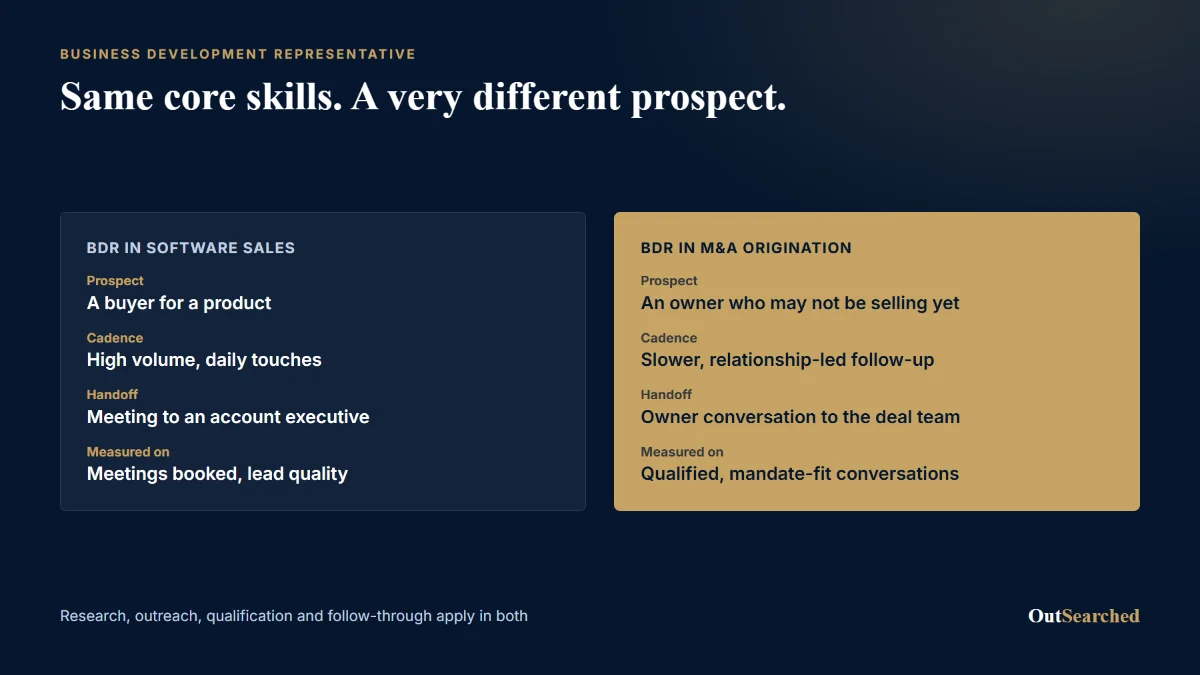
The core skills transfer directly: research, patient outreach and separating real interest from noise. But the cadence is slower, relationships matter more than volume, and one conversation with the right owner can lead to an acquisition months later.
A firm can build this function in-house or use a dedicated partner. Internal business development places one dedicated rep under your brand, while fractional business development uses a shared team.
Conclusion
The business development representative role is not glamorous, but it is a practical way into a sales career. Whatever the industry, the repeatable parts are the same: research, outreach, qualification and consistent follow-through.
Whether you are considering the job or hiring for it, judge it on the day-to-day work rather than the title.
Frequently asked questions
What does BDR stand for?
BDR stands for business development representative: the person who researches, contacts and qualifies new prospects, then passes warm leads to an account executive.
What is a business development representative?
A business development representative finds and qualifies prospects and schedules meetings with account executives. They work at the start of the sales process and do not close deals.
Is a BDR the same as a sales rep?
Not exactly. A BDR creates and qualifies sales opportunities. A sales rep or account executive negotiates terms with the customer and closes the sale.
Is a BDR role difficult?
It can be. The work involves regular rejection, a lot of calls and emails, and activity targets to meet. It suits people who are resilient and comfortable with repetitive outreach.
What qualifications does a BDR need?
Employers look for strong communication, familiarity with CRM software and some customer-facing experience. A four-year degree can help but is not always required.
How much does a BDR earn?
Payscale reports an average US base of $56,126, with a base range of $42k to $77k. The Bridge Group's 2025 study of B2B companies reports median SDR on-target earnings of $80K, made up of $55K base and $25K variable.
Need a BDR who talks to owners?
OutSearched runs direct-to-owner outreach for lower middle market buyers, with a dedicated or shared business development team.
Book a strategy call